AI Code Generation Trends 2026
The software engineering landscape of April 2026 has reached a definitive milestone. For decades, “coding” was synonymous with the manual labor of typing syntax—balancing brackets, debugging semicolons, and wrestling with language-specific quirks. But as of this month, that era is officially behind us.
At Sitara Innovations, we track the pulse of digital transformation, and the data is clear: the focus has shifted from the how to the what. We are no longer in the age of manual coding; we are in the age of AI Orchestration.
Chapter 1: The Google Milestone—75% and the “Customer Zero” Reality
At the recent Google Cloud Next 2026 summit, Sundar Pichai delivered a bombshell statistic that echoed across the tech industry: 75% of all new code at Google is now AI-generated and engineer-approved.
This is not a theoretical prediction for the future—it is the operational reality of one of the most advanced technology companies on Earth. Google serves as “Customer Zero,” proving that AI is no longer a peripheral assistant but the core operational layer of software engineering.
The “Intent-to-Code” Shift
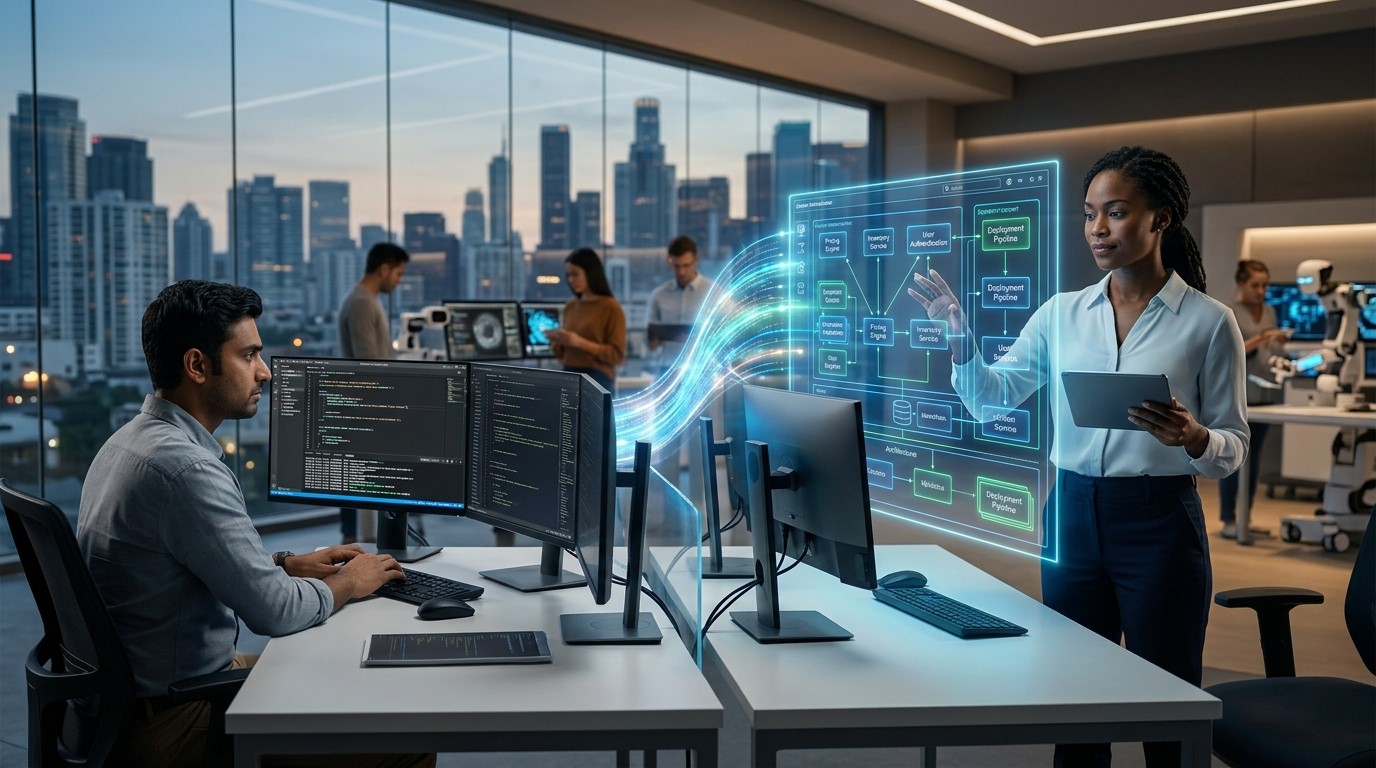
We are witnessing the “Intent-to-Code” shift. In this new paradigm, the developer’s primary tool is no longer the keyboard, but the High-Level Intent.
Developers are moving “up the stack.” When 75% of the boilerplate, logic, and integration code is generated by models like Gemini 2.0 or specialized agents, the human role evolves into that of a System Architect. You are no longer writing the lines; you are designing the blueprint.
Chapter 2: The End of Technical Debt—Self-Healing Codebases
Historically, Technical Debt has been the silent killer of business agility. Companies would rush products to market, leaving behind a trail of “spaghetti code” that would eventually become too expensive to maintain.
In 2026, the AI Code Generation Trend has introduced a revolutionary solution: Self-Healing Codebases.
How Autonomous Software Systems Reduce Debt:
-
Continuous Refactoring: AI agents now run in the background of your repository. They identify outdated design patterns or inefficient logic and automatically submit “Pull Requests” to update the code.
-
Legacy Migration: For businesses moving from WooCommerce to Shopify, or upgrading old PHP systems, AI can now handle complex code migrations in days rather than months.
-
Real-Time Security Hardening: As new vulnerabilities are discovered globally, AI agents automatically patch your code at the edge, ensuring your platforms—like AllthingsBNB or custom B2B portals—remain unhackable.
The Sitara Perspective: “Technical debt used to be an inevitability. In 2026, it’s a choice. With AI-driven maintenance, your code remains as fresh as the day it was written.”
Chapter 3: The Rise of the AI Orchestrator
If 75% of code is AI-generated, what do human developers do with the remaining 25%? They become Orchestrators. According to Gartner, by the end of 2026, 90% of software engineers will spend their time orchestrating distributed AI architectures rather than writing manual syntax.
The New Developer Skillset for 2026:
-
Prompt Engineering & Logic Design: Describing complex business goals in a way that AI models can translate into secure, executable code.
-
System Integration: Managing the “connective tissue” between various AI agents—the Coder, the QA Tester, and the Deployer.
-
Ethical & Security Auditing: Serving as the “Human-in-the-Loop” to ensure AI-generated code meets the highest standards of safety and brand integrity.
For a leader, “rolling up your sleeves” no longer means opening a text editor. It means mastering the System Design and ensuring that the AI agents are aligned with the business’s strategic vision.
Chapter 4: Impact on E-commerce and Professional Brands
This shift has a direct impact on how we build for brands like Rajahs or medical platforms like HK Medical.
In the old model, adding a complex B2B inquiry system to a WooCommerce store required hundreds of hours of custom PHP development. In 2026, we utilize Low-Code/AI-Native workflows. We describe the inquiry flow, the data validation rules, and the integration points. The AI generates the code, validates it against security standards, and deploys it.
Faster Speed-to-Market
The result? Development cycles that used to take three months now take three weeks. This allows businesses to be more experimental, launching new features and “Phygital” experiences at a fraction of the previous cost.
Chapter 5: How to Prepare Your Team for the AI-Generated Era
If you are a tech lead or business owner, the transition to 75% AI-generated code requires a cultural shift:
-
Adopt an “AI-First” Mentality: Every new project should start with the question: “How much of this can be architected by an agent?”
-
Invest in Governance: As code generation accelerates, your Review-Based Workflow must be airtight. Automated testing isn’t just an option; it’s mandatory.
-
Focus on Logic, Not Language: Stop hiring for “Java” or “Python” exclusively. Hire for Problem Solving and Systems Thinking.
Conclusion: The Future of Creation
The milestone of 75% AI-generated code is a signal that we have entered a new era of human creativity. By automating the “labor” of coding, we have unlocked the “art” of software design. At Sitara Innovations, we don’t just use these tools; we use them to build the future of our clients’ digital footprints.
The question for 2026 is no longer “Can AI code?” but “Are you ready to lead the AI that codes?”